TERRITORIAL TRANSITION AND EFFICIENCY: THE SYNERGY BETWEEN GRAIN AND BEEF CATTLE CHAINS FROM AN OPEN DATA PERSPECTIVE
DOI:
https://doi.org/10.63330/aurumpub.054-004Keywords:
Sustainability, Traceability, Geoprocessing, Beef cattle farming, Open dataAbstract
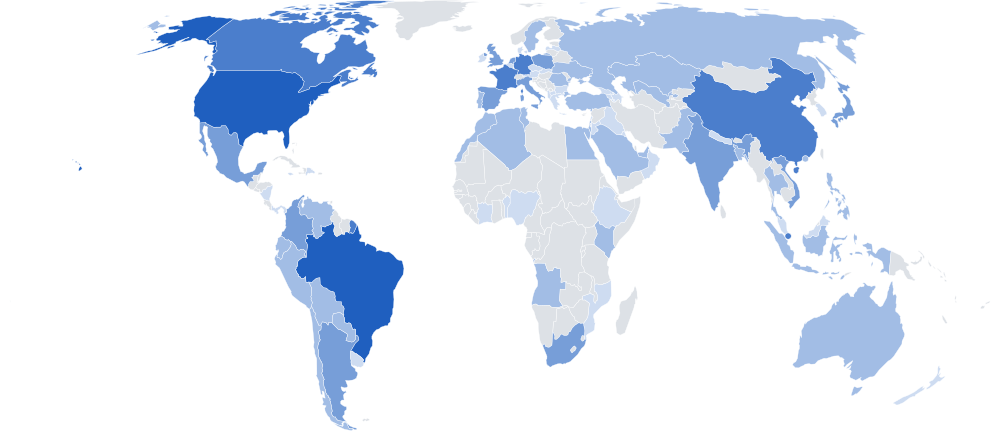
The advancement of Brazilian agribusiness has consolidated the country as one of the main global food suppliers, driven by significant gains in productivity and technical efficiency in grain production and beef cattle farming. However, the sector's continuous growth faces the challenge of reconciling increased production with growing international demands for sustainability and traceability. In this context, the present study aimed to analyze the global connections and local impacts of agricultural production in key regions, investigating trade flows and deforestation risk indicators associated with the soybean and beef supply chains. Methodologically, the research is characterized as an applied, quantitative and qualitative study, developed in an office setting through the collection and processing of secondary data obtained from the IBGE Automatic Data Retrieval System and the Trase digital initiative. The results show an intense dynamic of territorial transition in the last decade, in which the expansion of grain cultivation occurred concomitantly with the stabilization and increased production density of cattle herds in the same study area. From a socio-environmental governance perspective, the indicators reveal a consistent downward trend in the risk of deforestation associated with the soy supply chain, but conversely, the beef supply chain shows a slower and more fluctuating reduction, pointing to the monitoring of indirect suppliers as the main sectoral bottleneck. It is therefore considered that the future of sustainable agriculture lies in vertical optimization and the utilization of already anthropized territories through the land-saving effect, mitigating local ecological liabilities and ensuring the competitive insertion of the national market in the face of global ecological demands.
Downloads
References
CONAB – Companhia Nacional de Abastecimento. Perspectivas para a agropecuária brasileira: Safra 2025/2026. Brasília: Conab, 2025. Disponível em: https://www.conab.gov.br Acesso em: 09 mai. 2026.
EMBRAPA – Empresa Brasileira de Pesquisa Agropecuária. Visão 2030: o futuro da agricultura brasileira. Brasília: Embrapa, 2018.
IBGE – Instituto Brasileiro de Geografia e Estatística. Pesquisa Agrícola Municipal (PAM). Rio de Janeiro: IBGE/SIDRA, 2025. Disponível em: https://sidra.ibge.gov.br Acesso em: 10 mai. 2026.
IBGE – Instituto Brasileiro de Geografia e Estatística. Pesquisa da Pecuária Municipal (PPM). Rio de Janeiro: IBGE/SIDRA, 2025. Disponível em: https://sidra.ibge.gov.br Acesso em: 10 mai. 2026.
LIMA, Samuel do Carmo. O uso de dados estatísticos oficiais na análise geográfica do espaço agrário. Sociedade & Natureza, Uberlândia, v. 33, p. 110-125, 2021.
MAPBIOMAS. Projeto de Mapeamento Anual do Uso e Cobertura da Terra no Brasil. Coleção 8. São Paulo: MapBiomas, 2024. Disponível em: https://mapbiomas.org Acesso em: 12 mai. 2026.
MARCONI, Marina de Andrade; LAKATOS, Eva Maria. Metodologia do trabalho científico: procedimentos básicos, pesquisa bibliográfica, projeto e relatório, publicações e trabalhos científicos. 9. ed. São Paulo: Atlas, 2021.
PLATAFORMA BRASILEIRA DE BIODIVERSIDADE E SERVIÇOS ECOSSISTÊMICOS (BPBES). Relatório Temático sobre Agricultura, Biodiversidade e Serviços Ecossistêmicos: Sumário para Tomadores de Decisão. São Paulo: BPBES, 2024. Disponível em: https://www.bpbes.net.br/wp-content/uploads/2024/12/BPBES_Relatorio-Agricultura-2024.pdf. Acesso em: 11 mai. 2026.
RAJÃO, Raoni et al. The rotten apples of Brazil's agribusiness. Land Use Policy, v. 99, p. 104-118, 2020. Disponível em: https://doi.org/10.1016/j.landusepol.2020.104830. Acesso em: 18 mai. 2026.
SILIOTTI, Paulo; PINTO, Andréia; BARRETO, Adalberto. Transparência e dados abertos no monitoramento de commodities agrícolas no Brasil. Belém: Imazon, 2024. Disponível em: https://imazon.org.br. Acesso em: 15 mai. 2026.
TRASE. A pegada de desmatamento oculta na alimentação animal: integrando as cadeias da soja e da carne. Estocolmo: Stockholm Environment Institute (SEI); Oxford: Global Canopy, 2023. Disponível em: https://www.trase.earth. Acesso em: 17 mai. 2026.
TRASE. Trase Earth: Supply chain transparency for a sustainable economy. Stockholm Environment Institute e Global Canopy. Disponível em: https://trase.earth Acesso em: 17 mai. 2026.
Downloads
Published
Issue
Section
License

This work is licensed under a Creative Commons Attribution-NonCommercial-NoDerivatives 4.0 International License.