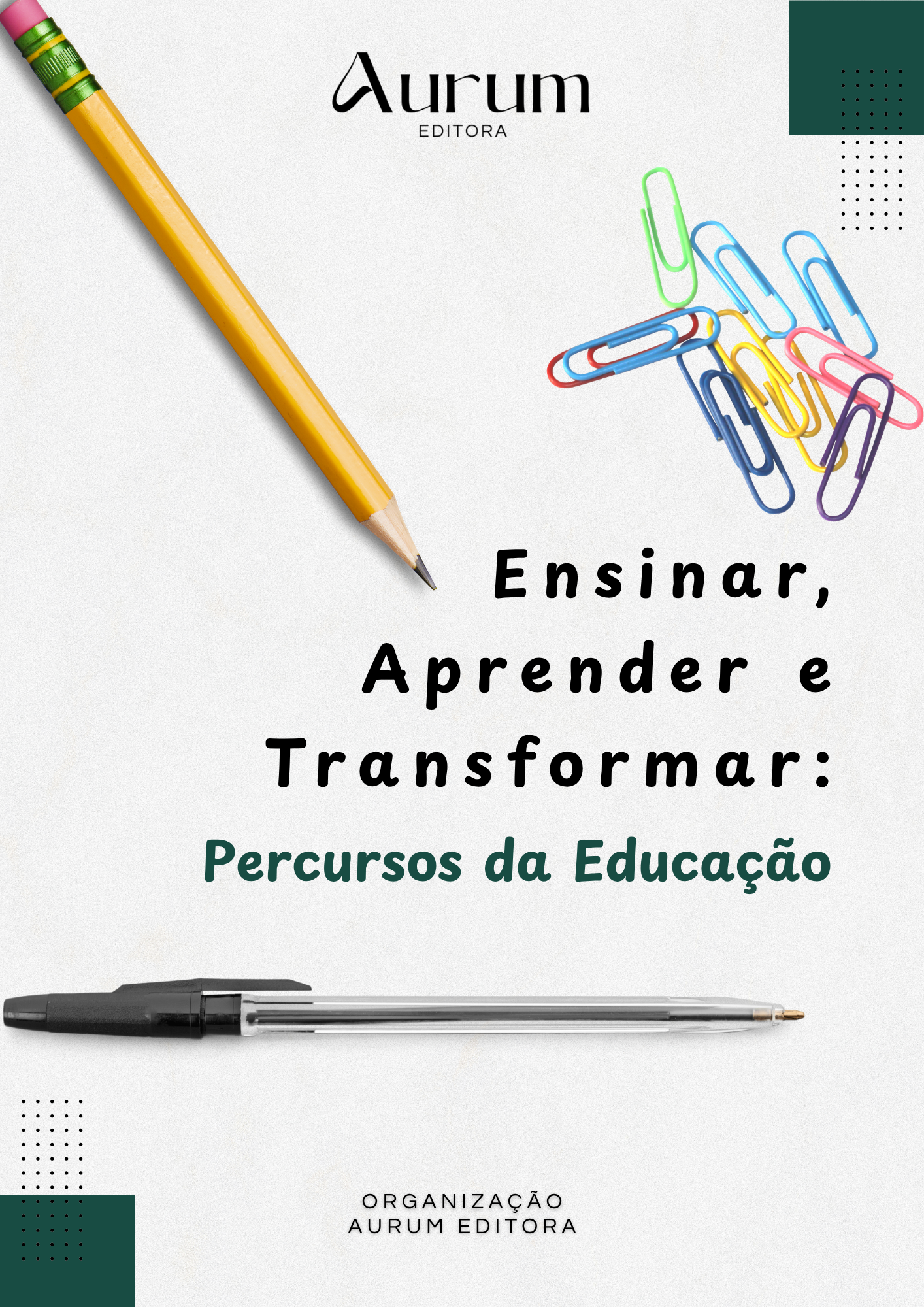
BILINGUALISM IN EARLY CHILDHOOD: EFFECTS OF ACQUIRING A SECOND LANGUAGE ON COGNITIVE PROCESSES
DOI:
https://doi.org/10.63330/aurumpub.067-128Keywords:
Bilingualism, Cognitive flexibility, Early childhood, Inhibitory controlAbstract
Bilingualism is the ability of an individual to understand and communicate in two different languages, while language is the means of communication used to express ourselves and create connections with others. Thus, the present study focuses on the theme "Bilingualism in early childhood: effects of second language acquisition on cognitive processes", seeking to answer the following question: can the acquisition of a second language in early childhood result in positive effects on children's cognitive processes? The objective of this work is to analyze the effects of second language acquisition on the cognitive processes of children during early childhood. To this end, a qualitative and descriptive bibliographic research was conducted. Data collection was carried out through the analysis of books and scientific articles, featuring contributions from several authors in the theoretical framework, such as: Bialystok (2022), Mackey and King (2007), Flory (2009), Megale (2019), Grosjean (2010), and Schelleter (2020). Upon completion of the study, it was found that early bilingualism acts as continuous training for the brain. Contrary to common sense, learning two languages from childhood does not generate higher intelligence compared to a monolingual individual; rather, what actually occurs is that bilingual children have an advantage regarding executive functions, characterized by strong cognitive flexibility and sharp inhibitory control.
Downloads
References
BIALYSTOK, Ellen. Bilingualism in development: language, literacy, and cognition. Cambridge: Cambridge University Press, 2001.
BIALYSTOK, Ellen. Bilingualism as a slice of apple pie. International Journal of Bilingualism, [S. l.], v. 25, n. 4, p. 863-867, 2021.
BIALYSTOK, Ellen. Bilingual children: families, education and development. New York - Paris: TBR Books, 2022.
BLOOMFIELD, L. (1933). Language. New York: Holt, Rinehart and Winston.
BRASIL. Ministério da Educação. Base Nacional Comum Curricular: educação infantil e ensino fundamental. Brasília, DF: MEC, 2018. Disponível em: https://www.gov.br/mec/pt-br/escola-em-tempo-integral/BNCC_EI_EF_110518_versaofinal.pdf. Acesso em: 20 nov. 2025.
BRASIL. Lei nº 9.394, de 20 de dezembro de 1996. Estabelece as diretrizes e bases da educação nacional. Brasília, DF, 1996. Disponível em: https://www.jusbrasil.com.br/legislacao/1879078200/lei-de-diretrizes-e-bases-da-educacao-nacional-de-1996-lei-9394-96. Acesso em: 20 nov. 2025.
DE HOUWER, Annick. The acquisition of two languages from birth: a case study. Cambridge: Cambridge University Press, 1990.
DEWEY, John. Experience and education. London: Collier Macmillan Publishers, 1938. (The Kappa Delta Pi Lecture Series).
FLORY, Elizabete Villibor; SOUZA, Maria Thereza Costa Coelho de. Bilinguismo: diferentes definições, diversas implicações. Intercâmbio, São Paulo, v. 19, p. 23-40, 2009.
FLORY, Elizabete Villibor; SOUZA, Maria Thereza Costa Coelho de. Bilinguismo precoce e desenvolvimento infantil sob a perspectiva da psicologia genética: resenha de literatura. Psicologia: Teoria e Prática, São Paulo, v. 11, n. 2, p. 159-170, 2009.
GENESEE, Fred. Early childhood bilingualism: perils and possibilities. Canadian Psychology/Psychologie canadienne, [s. l.], v. 56, n. 1, p. 6-15, 2015. Disponível em: http://dx.doi.org/10.1037/a0038599. Acesso em: 20 nov. 2025.
GROSJEAN, François. Bilingual: life and reality. Cambridge, MA: Harvard University Press, 2010. Disponível em: ProQuest Ebook Central. Acesso em: 9 out. 2025.
KING, Kendall; MACKEY, Alison. The bilingual edge: why, when, and how to teach your child a second language. New York: HarperCollins, 2007. E-book.
LENT, Roberto. O cérebro aprendiz: neuroplasticidade e educação. Rio de Janeiro: Atheneu, 2019.
MEGALE, Antonieta (Org.). Educação bilíngue no Brasil. São Paulo: Richmond: Fundação Santillana, 2019.
OLIVEIRA, Hérvilla Maria Santos; SILVA, Rivaldo Ferreira da. Ensino de língua inglesa para crianças à luz do método Montessori. Open Minds International Journal, São Paulo, v. 5, n. 3, p. 99-114, 2024.
PAZ, Sherlie; ALFANO, Alliete R.; MEDINA, Angela M.; HAYES, Timothy. Speech-language pathologists ’perceptions of childhood bilingualism. Clinical Linguistics & Phonetics, [s. l.], v. 38, n. 1, p. 1-20, 2024. Disponível em: https://doi.org/10.1080/02699206.2022.2152729. Acesso em: 14 nov. 2025.
PEAL, Elizabeth; LAMBERT, Wallace E. The relation of bilingualism to intelligence. Psychological Monographs: General and Applied, Washington, DC, v. 76, n. 27, p. 1-23, 1962. (Whole No. 546).
PIAGET, Jean. A psicologia da criança. 13. ed. Rio de Janeiro: Bertrand Brasil, 1994. (Original publicado em 1966).
SACRISTÁN, José Gimeno. O currículo: uma reflexão sobre a prática. Porto Alegre: ArtMed, 2000.
SCHELLETER, Christina. Introduction to bilingualism. London: Red Globe Press: Macmillan Modern Linguistics, 2020.
TRASK, Robert Lawrence. Linguagem: os conceitos básicos. Tradução de Rodolfo Ilari. São Paulo: Contexto, 2008.
VIGOTSKI, Lev Semionovitch. Imaginação e criação na infância: ensaio psicológico: livro para professores. Tradução de Zoia Prestes. Apresentação e comentários de Ana Luiza Smolka. São Paulo: Ática, 2009.
VIGOTSKI, Lev Semionovitch. Pensamento e linguagem. Tradução de Jefferson Luiz Camargo. 4. ed. São Paulo: Martins Fontes, 2008 (Original publicado em 1934).
ZAVAGLIA, Claudia. Ambigüidade gerada pela homonímia: revisitação teórica, linhas limítrofes com a polissemia e proposta de critérios distintivos. DELTA: Documentação de Estudos em Lingüística Teórica e Aplicada, São Paulo, v. 19, n. 2, 2003. Disponível em: https://www.scielo.br/j/delta/a/xSPnXGXhqcZdfx8zpXjrP9S/?lang=pt. Acesso em: 7 nov. 2025.
Downloads
Published
Issue
Section
License

This work is licensed under a Creative Commons Attribution-NonCommercial-NoDerivatives 4.0 International License.